
Child Nutrition/School Cafeterias
K-12 schools have a special role in reducing, recovering, and recycling food waste on their premises and in educating the next generation about recovering wholesome excess food for donation and about reducing food waste to conserve natural resources.
Reduce
The best place to start in reducing food waste is not to create it in the first place. This is also called source reduction. School district kitchens and cafeterias can minimize disposal and procurement costs by implementing simple waste prevention procedures. Consider the following waste prevention strategies when developing a waste reduction program.
Zero-Waste Lunches
Zero-waste lunches reduce waste by packing a lunch with reusable drink and lunch containers, utensils, and packing food that your student will eat. This requires a little extra thought when packing, but it creates considerably less waste and reduces costs in the long run.
- According to the U.S. EPA, packing a waste-free lunch saves an average student $250 and 67 pounds of trash per nine-month school year.
- U.S. EPA developed a Waste-Free Lunch poster to help students learn how to reduce, reuse, and recycle items in their school lunches.
Purchasing Considerations
Thoughtful purchasing practices take into account packaging, a product’s shelf-life, and whether the item is recyclable or will eventually end up in a landfill. School administrators can audit students’ meal preferences to reduce excess food waste. Consider the following:
- Is there an option with less packaging?
- Will some of this product spoil before it is all used?
- Is there a less perishable product available in bulk?
- Can reusable food service items be purchased instead of disposable items?
- Are there recycled or other environmentally preferable products available?
- Is the product recyclable or compostable?
- Which meals or food items do students prefer to eat?
Recover/Reuse
Food Donation is also called food recovery. The USDA strongly encourages schools to donate leftover food to recovery organizations.
For more information, see Reducing Food Waste at K-12 Schools from the USDA.
- CDE’s Plate Waste Prevention in Child Nutrition Programs (CNP)
- U.S. EPA also provides tools for preventing and diverting wasted food, including “Food Waste Audits: A Resource for Schools” guidebook.
- The Use of Share Tables.
- It is still allowable for students to save food items from their meal service for later consumption, as long as those items do not require cooling or heating. The CDE’s Food Consumption Outside the Foodservice Area bulletin provides guidance regarding this policy.
- USDA Guidance on Donation of Leftover Food in CNPs.
Some school districts also offer specific guidance, policies, and programs related to school food donation.
- Los Angeles Unified School District
- Oakland Unified School District PDF download
- Ramona, San Diego and Vista Unified School Districts
- Additional K-12 and college food scraps programs
Animal Feed. Leftover food not suitable for human consumption can be used to feed animals or given to companies that convert food discards into commercial animal feed and pet food.
Other Ideas for Reuse. Before recycling or disposing of resources from food service areas, teachers should be informed about surplus materials that may be used as classroom supplies, for school events, in play productions, and for other creative uses.
- For example, some food service items, such as egg cartons, milk cartons and jugs, steel cans, and cardboard boxes, are popular components of student art and science projects.
- Reusable food-service items, such as five-gallon buckets, can also be used in other areas of the school, including the school garden.
Compost/Recycle
Composting inedible fruit and vegetable food scraps from a food preparation or dining area can be done on site, or materials can be taken to acomposting facility that is permitted to accept food scraps. Composting yields a rich soil amendment that can be used in gardens and landscaping, and saves water and money spent on soil conditioners and fertilizers. Composting programs also complement school garden program efforts, both of which supplement and support classroom instruction.
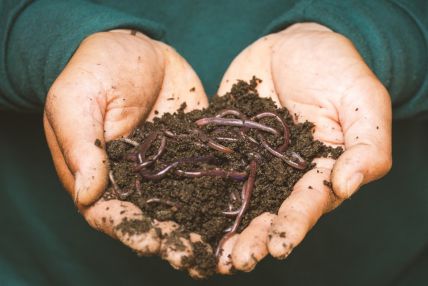
Vermicomposting is the practice of using worms to transform non-meat or non-dairy food scraps into a nutrient-rich finished product called vermicompost. In a school setting, a vermicomposting system can support classroom science experiments and produce a finished product for use in school gardens.
Recycling. It is important to find recycling opportunities for your school district by checking with your city or county recycling coordinator, trash hauler, and local recycling companies. Certain organizations, like the American Forest & Paper Association (AF&PA) and the Carton Council, provide tools to help make your recycling program a success.
Additional Resources
- Smarter Lunchrooms Movement – This movement’s mission is to equip school lunchrooms with evidence-based tools that improve child eating behaviors and thus improve the health of children.
- School Nutrition Association – current national news in child nutrition and an expansive resource center with downloadable publications.
- K-12 School Food Recovery Roadmap – A guide showing the steps and initiatives taken at Oakland and San Diego Unified School Districts to reduce and recover school meal leftovers.
For more information contact: Schools Program, Schools@calrecycle.ca.gov.